

Inspiration


Terry Pratchett indicates in his Discworld series that inspiration is a stream of particles flowing through the universe, a constant backdrop that occasionally strikes a receptive mind. Of course, what sort of inspiration and how it manifests can be highly variable, from the literary genius of Hwel the dwarf (Pratchett's Shakespeare stand-in: apparently "Hwel" is the Welsh variation on "Will," vowels optional), to the polymath manifestations of Leonard of Quirm, to the...well, stupid ideas brought into horrible, horrible reality by Blood Stupid Johnson (seriously: he decided to round pi to 3 for simplicity...and then somehow made his creations using this calculation without them falling down, though they do tend to cause sudden hops through space and time if you step on them wrong).
Mark Twain is reported as writing in his 1906 autobiography that "There is no such thing as a new idea. It is impossible. We simply take a lot of old ideas and put them into a sort of mental kaleidoscope. We give them a turn and they make new and curious combinations." There's an interesting blog article with loads more quotes like that on the subject. To some, that might seem like fuel for frustration. For me, I see it as a relief: it means I don't have to worry about being original anymore; instead, I can just focus on the act of creation, on the bits that make me feel most alive.
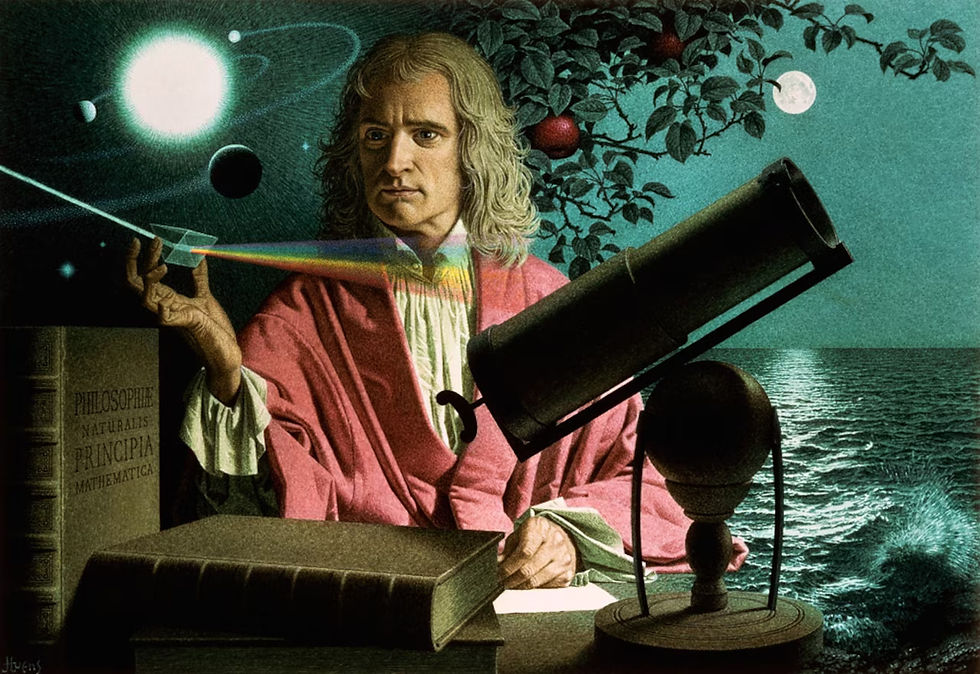
The notable author Steven Berlin Johnson (with whom I am regularly conflated, but I don't mind at all since he's an awfully good author, in my opinion, though I expect he's rather annoyed about being associated with me, if he's even aware that I exist, which I doubt) has an awful lot to say on the subject, about 16 books worth last I checked. Similarly, when Sir Isaac Newton was asked about how he figured out his ideas on physics, which included gravitational laws, he didn't credit the apple falling on his head story, but rather said it was by "patient thought" and "By thinking about it all the time."
Funny thing is, I'm writing a good chunk of my doctoral dissertation on learning and teaching ("pedagogy," the academic study of teaching - teaching is a meta-skill, like writing, or a skill that requires other skills in order to be used, but which also needs to be developed on its own as a separate skill), so I've been putting a lot of thought into the idea of how to inspire ideas in others. Which, I suppose rather naturally, leads me to consider where I get my own ideas.
The simple answer is: I read a lot, I think a lot, I pray a lot for additional inspiration, and then I work to make connections between the different ideas that I encounter. Writing in science fiction has taught me that everything is made of the same stuff, you see. Einstein figured that one out with E = mc2, which is basically saying that everything is made of light. No accident, then, that the flash of ideas finding realization and awakening understanding is called "enlightenment."
There is no wasted learning: there is only learning that we haven't learned to use properly yet.
For me, I like to browse tabletop roleplaying books. The old Steve Jackson GURPS system, especially serves as a source of perennial inspirations, since the whole point of those books is to present a host of carefully researched ideas in a compact format for use by amateurs wanting to know more so that they can make use of the information for inspiration in the rough-and-tumble, roll-and-rumble world of the joint storytelling of tabletop roleplaying games. I actually made use of GURPS Mythic Greece, Imperial Rome, and Swashbucklers to get me through a college 200-level middle-range Western history course with an A, they're that well-researched. But if you're looking for ideas given expression, most tabletop game books will do much the same thing, providing a starting point, a flash of inspiration, a set of concepts and rules and settings that can provide the fuel for your own fires of imagination.

The point, then, in reading anything or watching anything, is to break it down into its component parts. Even if something is objectively bad, or even downright awful, as I often encounter when I plow my blissful way through my ever-expanding (and ever-expending) "to read" and "to watch" lists, there is a mass of inspiration to be gleaned from the work. What is it trying to do? What is it trying to accomplish? What parts were actually not bad? What went wrong, why, and how could it be fixed? Proactive and optimistic thinking are essential, as well as a willingness to take the source material and run in whatever direction your little heart most desires.
This sort of activity can be seen in the works of Steven Spielberg, who made a vast host of films based on books, from Jaws to Who Framed Roger Rabbit to Jurassic Park. The books and the films are, as many fans of one, both, or neither, have pointed out, are all-too-often completely different from each other, or at least differ in some genuinely critical ways. Naturally, some adjustment of written works is necessary in order to make the transition to a new audiovisual medium, but Spielberg's changes go well beyond that. In my opinion, this tends to make them into vastly better stories. What he is doing, then, is taking the core essence of those stories, their hearts and souls, and reshaping them to tell the story that they could have shared, the story that he wanted them to tell, if only the authors had his vision.

For me, this amounts basically to taking whatever I've encountered, metaphorically smashing it on the floor, then starting to sift through the pieces. Nothing is sacred to me in this process, and I mean that quite literally. This process of inspiration can be quite dangerous, since it means that in the process I will be revising myself right alongside my works. This is the danger of inspiration, of learning, of bringing something new into the world out of the parts that others didn't appreciate properly before. But take that Mark Twain quote up above, about the originality of ideas, and then use it optimistically: because nothing is new, that means you can just mess around without worrying! Because while everything has been done before, it hasn't been done by you.
To further expand this idea about ideas, here are two examples that I've used and am still using as part of my process of creative development. Sources, in other words, that in all honesty aren't all that good, but which have some really cool ideas that I've been using ever since I was first exposed to them.
The first example is the European horror roleplaying game Kult. To preface any further statements on the game, I have reviewed both the original edition and the most recent edition, and have found both functionally unplayable. The newer edition isn't quite so bad in this respect, since it keeps its major elements in a single reasonably coherent book, while the older edition rambles across multiple sourcebooks, occasionally repeating itself, occasionally contradicting itself, ultimately lacking a fundamental sort of cohesion as the authors just slap down whatever strange ideas occured to them in an Allen Ginsbergian stream-of-consciousness, except fueled by watching too much Hellraiser rather than because of LSD-induced free association. I think.
To sum up the setting, humanity used to be a powerful, monstrous collection of creatures. We ruled whole swaths of reality, ultimate tyrants over all we surveyed. But then we were overpowered by a being called the Demiurge and shackled into our present mortal selves, forced to progress through mortal life, death, hell, and reincarnation, over and over again. In the game, this translates to the players being quite suddenly, and often without any prior warning or justification, jerked across time and space and into new and weird states of reality and planes of existence, a state of being which is portrayed rather well in the old-time comic book miniseries based on the game. Of course, this being a horror game set in a bleak universe, all of the places you might end up are awful, the only difference being in how, exactly, they're awful. In other words, the game works to achieve horror through disorientation as well as the various showcase elements in which the players of the game might find themselves, or the monsters that constantly stalk them.
Ultimately, to succeed in the game, you as the player are supposed to embrace becoming a monster yourself, turning into something even more awful than the creatures that presently act as your conceptual jailers. This, for me, is the biggest reason why I just can't find myself able to actually play it with anybody I know - or want to know, for that matter! It's certainly effective as a horror game, and I won't doubt for a moment its capacity to do just what it sets out to accomplish. The problem is, part of what it's trying to accomplish is the corruption of the players of the game, not just their characters, and that's just not acceptable to me.
Setting all that aside, and even accepting that I can't ever actually play this game, if I crack it open and goosh around inside, I find all sorts of useful ideas. The concepts behind the monsters are fantastic, for instance, as are the many and interesting horrific places you can go. And, of course, the overarching theme of accepting corruption for the sake of power can be taken straight to develop flawed heroes bound for a fall or villains who happily jump. Or the whole idea can be turned on its head to indicate the proactive stance required for anybody in a hopeless situation to upend the status quo completely and start over with a new set of rules that favor the character. In this case, if you're expected to become a monster, instead you might embrace the power of monstrosity, then not be corrupted by it, instead sharing it and helping others to develop their own power, good hero-kings rather than demonic tyrants.
In other words, break it apart, then put it back together with the pieces you like best, in a configuration that suits your way of thinking. What "it" is isn't really important: all that matters is that you're digging out the gold that you need and using it where it will do the most good. Like kintsugi pottery: making something new out of what was once broken.

A second - and, I promise, final - example comes from my overarching weakness for bad movies. Back when there were still video rental stores, I could never be trusted to roam the aisles alone, because I would always come back with a stinker. If I-Mockery has an article on it, I'd probably be drawn to it like a fly to...well, you know (Oh! And incidentally: the website developer of I-Mockery is actually a decent person; he was open and willing to talk to me and answer my questions, and since I know myself, anybody who's willing to do that has to be astoundingly patient and kind on a fundamental level).
One of my favorite bad movies, though, one that I actually enjoy watching even to this day, is the Dolph Lundgren and Frank Langella 1987 version of Masters of the Universe. I can make no adequate apologies if you happen to seek out this film on your own...though, honestly, I actually do like it, but then, I enjoyed the 2011 disaster that was Green Lantern, so let's just call my sense of good taste fundamentally flawed and move on.
Dimension travel, time travel, alternate worlds, rebel forces fighting against a tyrannical usurper, swords-and-sorcery, guns-and-weird science: what's not to love! (No, that is not a question: we have already established my ability to determine the relative value of creative works.) Especially when you consider how gritty the Masters of the Universe franchise was at its start, I'd say that the "darker & edgier" version of Eternia presented in the film is a callback to its origins rather than a re-imagining.
Setting all that aside, though, what is there to be taken from and used in the 1987 Masters of the Universe film? What sort of gold can be panned out from dross like this? Glad you asked! The simple answer is the characters, especially the villains. Seriously, that's what keeps drawing me back: it's the excellent use of archetypes so elemental in their nature, they're immediately recognizable without need for any lengthy backstory or tale of origins. The moment somebody like the Beast Man, Saurod, Blade, or Karg steps out onto the screen, you can tell right away just what this guy's specialty is and what he's going to be like and how he's going to fit into the overall plot. Evil-Lyn makes a fantastically chilling second-in-command and dark magical femme fatale, Frank Langella's scenery chewing is the driving force that energizes the plot, and even the bad guy hench-robots have a surprising degree of variability, so they never stop presenting new and interesting challenges to the protagonists, while still fulfilling their purpose as necessary mooks for the cannon fodder engine.
Whenever I write bad guys, this awful, wonderful film (whether you think it's wonderfully awful or awfully wonderful) is my immediate go-to for inspiration.
The takeaway from all of this can be summed up thusly:
"I am now convinced," said Don Quixote, "that he who reads and travels much will see and learn a great deal." - from Chapter 25 of Part II
translated from "Yo me doy por satisfecho, que quien mucho lee y mucho viaja, mucho ve y mucho sabe."
Also: “El que lee mucho y anda mucho, ve mucho y sabe mucho.” - "The one who reads much and travels much, sees much and knows much." - Spanish proverb derived from the Don Quixote quote above
And see https://eclecticlight.co/tag/don-quixote/ for some very well-written notes on and historical pictures from that book - I used it as a post-reading guide to see what I'd missed on my first reading.
Also, I share this image by Gustave Dore of Sancho Panza embracing Dapple, his donkey, and weeping because I think it's so beautiful. No other reason.
Go, do, and think. Then start to make connections, clearing your soul of its uncounted preconceptions. Accept inspiration, then put in the work to make it into reality.


Comments